Pad Printing Technology: Historical Origins and Technical Mechanisms
In the world of industrial manufacturing, aesthetic appearance is as critical as functionality. The ability to print with high precision on 3D surfaces with complex geometries is one of the biggest challenges of modern manufacturing. Pad printing is the most sophisticated engineering answer to this challenge.
1. Introduction and Historical Context
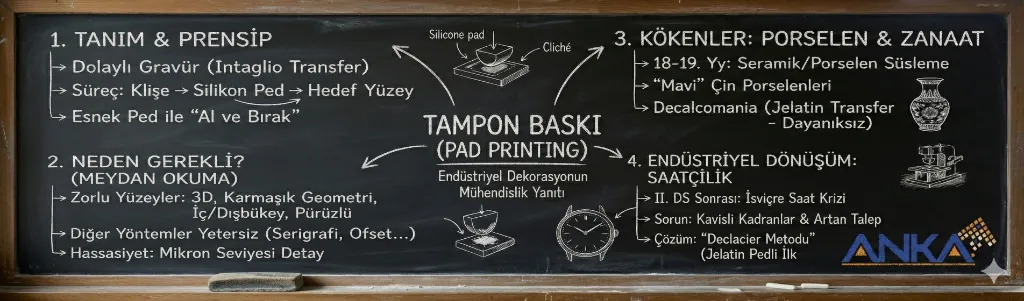
Pad printing, fundamentally an indirect intaglio transfer process, relies on the principle of transferring an image from a cliché to a target surface via a flexible silicone pad.
1.1. Origins: From Porcelain to Watchmaking
Roots trace back centuries to the decoration of "blue" Chinese porcelain. However, the real turning point was the production crisis in the Swiss watch industry after WWII. The bottleneck in painting watch dials led to the birth of the first industrial machines ("Declacier Method").
1.2. The Silicon Revolution (1968)
In the mid-1960s, Wilfried Philipp discovered the "magic" material to replace gelatin: Cold vulcanized silicone.
- Low Surface Energy: Transfers ink with nearly 100% efficiency.
- Mechanical Memory: Retains form even after thousands of prints.
- Chemical Resistance: Resistant to aggressive solvents.
2. Physical and Chemical Mechanisms
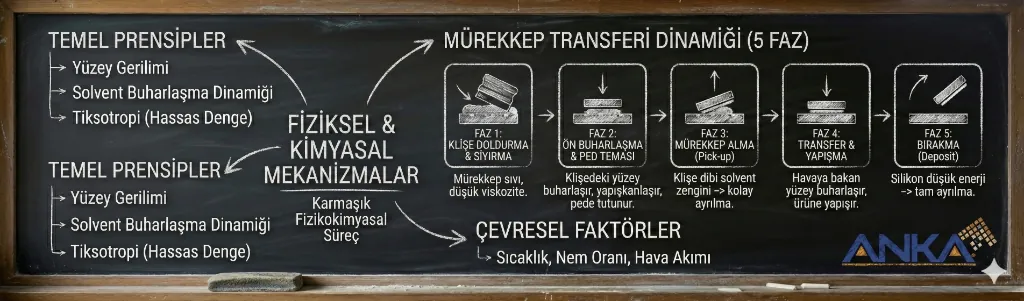
Pad printing relies on a delicate balance of surface tension and thixotropy principles.
2.1. The 5 Phases of Ink Transfer
- Inking: Ink fills the cavities of the cliché.
- Pre-evaporation: Solvent evaporates, making the ink tacky.
- Pick-up: The pad lifts the tacky ink from the cliché.
- Transfer: Solvent evaporates from the outer surface as the pad moves to the product.
- Deposit: The pad presses onto the product, and the ink releases completely.
2.2. Surface Energy and Adhesion
For a successful print, the surface energy of the material must be at least 38-42 Dyne/cm. For low-energy plastics like PP and PE, Corona or Flame Treatment is mandatory.
3. Analysis of System Components
3.1. Silicone Pad Technology
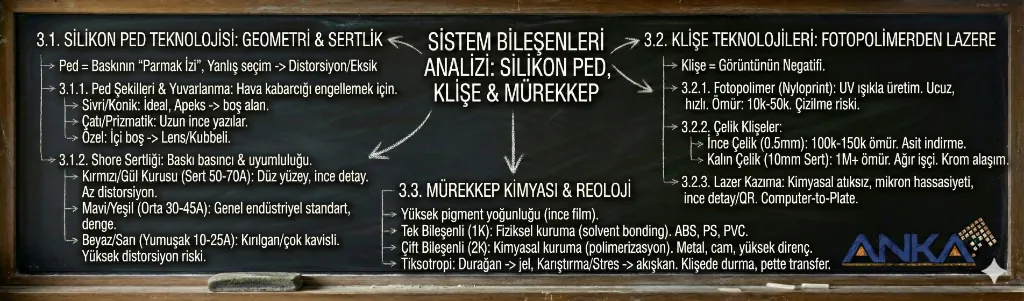
Pads are like the "fingerprint" of the print job.
- Pointed/Conical Pads: The ideal form to prevent air entrapment.
- Red Pads (Hard 50-70 Shore): For flat surfaces and fine details.
- White Pads (Soft 10-25 Shore): For fragile objects like eggs.
3.2. Cliché Technologies
- Photopolymer (Nyloprint): Fast and cheap, for short runs (10k-50k).
- Steel Clichés: 1 Million+ print life, the automotive standard.
- Laser Engraving: Chemical-free, modern method with micron precision.
4. Machine Technologies and Automation
4.1. Open vs. Sealed Cup
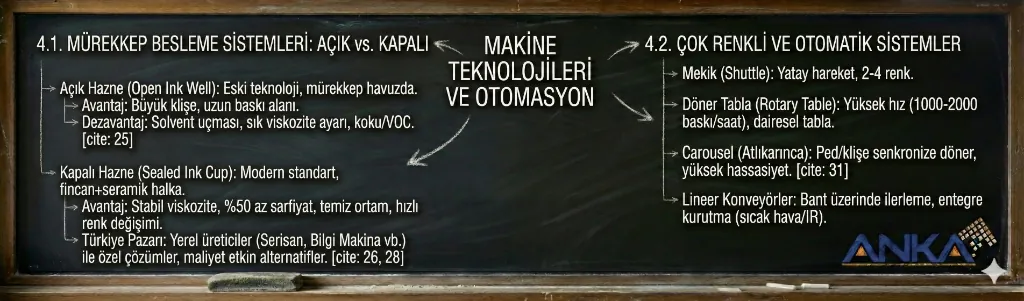
- Open Well: Old technology. Good for large clichés but high solvent evaporation.
- Sealed Cup: Modern standard. Ceramic ring ensures sealing. Viscosity remains stable for days, cleaner environment.
4.2. Automation
With Rotary Tables and Carousel systems, speeds of 2000+ prints per hour are achievable.
5. Industrial Applications
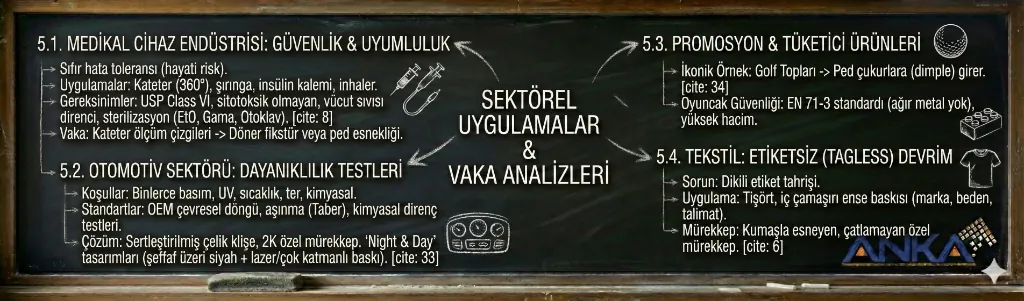
- Medical: USP Class VI compliant, sterilization-resistant prints on catheters and syringes.
- Automotive: "Night & Day" designs, abrasion and UV resistant interior trim buttons.
- Textile: "Tagless" neck labels that do not irritate the skin.
Future and Global Role
Sustainability-focused Eco-inks and digital integrations are shaping the future. Turkey, with manufacturers like Serisan and Bilgi Makina, is a global production hub in this field.